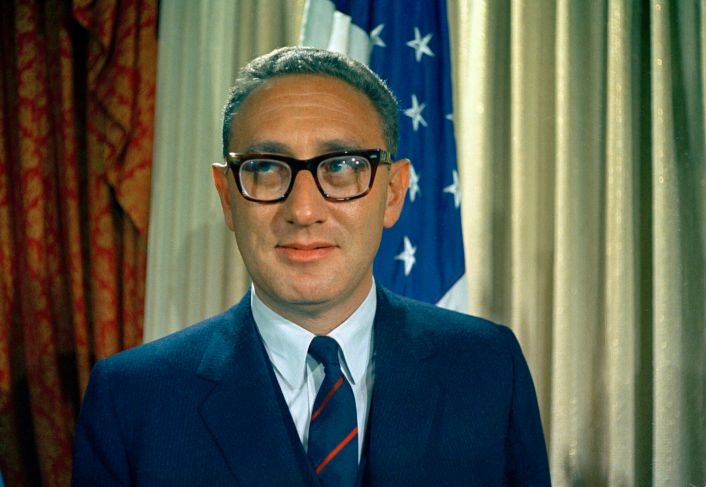
Love him or hate him, Henry Kissinger was arguably the most important diplomat of the second half of the last century and right up to his death this week at age 100.
His tenure as a Harvard professor saw him publish scholarly works on the concept of the balance of power emanating from the Congress of Vienna in 1825 that kept Europe at peace for a century. His work was required reading when I pursued my history degree at McGill University in the sixties.
In 1968, he became National Security advisor to President Richard Nixon and, in 1973, Secretary of State. He served under Mr. Nixon until the latter’s resignation and then continued under President Gerald Ford until the end of Ford´s term in 1977.
Afterwards, he was a much sought after political advisor to world leaders and leading business personalities. He continued to write prolifically and the mere mention of his name thrilled supporters and raised the hackle of detractors.
Why these contradictory feelings?
Kissinger was a product of his times. A refugee from Hitler’s Germany, he was a confirmed anti-communist during the cold war. He applied his deep knowledge of the intricacies of balance of power to the post war bi-polar world that became his stage.
His ability to craft a China policy that drove a wedge between the Soviet Union and the Peoples’ Republic of China was a brilliant masterstroke of realpolitik. He orchestrated Mr. Nixon’s visit to China, the diplomacy of détente with the Soviets, and the beginnings of a dialogue between Israel and Egypt that led to the Camp David Accords of 1979.
In the context of the seventies, his vision and actions seemed to make sense in a world conflicted between the first world and the second world, as they fought for influence and control over the third world.
The Paris Peace Accords that he negotiated to end the Vietnam War was little more than a capitulation to an enemy the U.S. no longer had the stomach to fight. His policy of bombing Laos and Cambodia did little to whittle down the Vietnamese fight for freedom and independence.
Kissinger knew the U.S. could not win, so he signed the Paris Treaty and implemented Mr. Nixon’s slogan of “Peace with Honor”. Two years later, Saigon fell and the North Vietnamese consolidated their hold over all of Vietnam.
In a world where communism and liberalism fought for predominance, Kissinger’s move to overthrow Chile’s elected Socialist President Salvador Allende and replace him with a military dictatorship seemed to be the right policy as the U.S. sought to avoid a second Cuba in the hemisphere.
In Kissinger’s world, dictators were a necessary evil. As one of his predecessors John Foster Dulles once observed, they may be sons of bitches, but they are our sons of bitches.
Today, blame for the Pinochet regime’s vicious rule is still a cause for Latin American suspicion of U.S. policies in the region. And Kissinger was its architect.
Getting back to the Middle East, Kissinger’s pursuit of “shuttle” diplomacy underscored the brilliance of a superb diplomat creating personal networks and creating threads of dialogue between enemies to eventually bring them to the same table.
His personal friendships with Egyptian President Anwar Sadat and Israeli Prime Minister Golda Meir and her successor Yitzhak Rabin served the world well as he shuttled between Cairo and Jerusalem to negotiate an Israeli withdrawal from the Sanai and the return of the Suez Canal to Egyptian control.
This set the stage for President Sadat’s visit to Israel in 1977 and the Camp David peace accords under U.S. President Jimmy Carter.
Historians can debate whether these developments could have taken place without Kissinger’s laying the foundations.
In my opinion Kissinger was responsible for the positive elements that led to the peace that has now become reality between Israel and several Arab states.
But ignoring the aspirations of Palestinians and their demands for a Palestinian State as called for by the relevant Security Council resolutions has led to today’s the situation where terrorism is rampant, and thousands are being killed on both sides.
So, as he passes into history, Kissinger’s legacy is indeed mixed. While he reflected the political morality and necessities of the realpolitik of his day, his actions today would leave much to be desired.
Keep reading: JFK
Edición: Fernando Sierra
El Pacífico sur es una de las regiones más vulnerables del mundo al calentamiento global
Afp
El apoyo mensual es de 9 mil 582 pesos, además de seguro médico del IMSS
La Jornada
Visión Intercultural
Francisco J. Rosado May
Las piezas son resguardadas por el INAH en el Laboratorio de Zooarqueología de Chetumal
La Jornada Maya